Manufactured Housing Performance Playbook

Manufactured Housing KPIs: The Essential KPI Playbook for Manufactured Housing Operators

Manufactured housing KPIs are the operating metrics that tell you whether your communities are healthy, drifting, or quietly underperforming.

For manufactured housing owners, operators, and asset managers, tracking the right KPIs is critical. Lot-based revenue, collections timing, expense leakage, and resident turnover behave very differently than in traditional multifamily.

This manufactured housing KPI playbook shows:

  • The most important KPIs to track

  • Why they matter specifically in manufactured housing

  • How top operators use KPIs as an early warning system

What Is a Manufactured Housing KPI?

A manufactured housing KPI (Key Performance Indicator) is a measurable metric used to monitor the financial and operational performance of manufactured housing communities and portfolios.

Unlike generic real estate metrics, manufactured housing KPIs focus on:

  • Lot occupancy instead of unit occupancy

  • Rent collections timing

  • Expense efficiency on a per-lot basis

  • Stability of long-term residents

These KPIs help operators move from reactive management to proactive asset oversight.

Why Manufactured Housing KPIs Matter

Manufactured housing is often viewed as “simple,” but under the surface, small issues compound quickly.

Manufactured housing KPIs help operators:

  • Identify underperforming communities early

  • Spot collection problems before cash flow is impacted

  • Control operating expenses before NOI erosion

  • Support valuations, refinancing, and exits with clean data

Without consistent KPI tracking, problems usually show up too late — after NOI has already taken a hit.

Core Manufactured Housing KPIs Every Operator Should Track

Below are the core manufactured housing KPIs used by disciplined operators and asset managers.


Occupied Lots (%)

  • Measures the percentage of rentable lots currently occupied

  • Primary driver of revenue stability

  • Early signal of leasing or retention issues


Economic Occupancy

Economic Occupancy

  • Reflects rent actually collected versus rent billed

  • More meaningful than physical occupancy alone

  • Highlights hidden revenue loss from delinquency


Rent Collection Rate (By Day 5 / Day 10)

  • Tracks how much rent is collected early in the month

  • Critical for cash flow predictability

  • Strong indicator of resident quality and enforcement effectiveness


Delinquency Rate

  • Measures unpaid rent as a percentage of billed rent

  • Early warning for collections breakdown

  • Often precedes rising bad debt and turnover


Average Rent per Lot

  • Tracks rent growth and pricing power

  • Used to evaluate market positioning

  • Important for underwriting and valuation assumptions


Bad Debt (%)

  • Measures uncollectible rent written off

  • Often understated or reviewed too late

  • Key KPI for understanding true economic performance


Operating Expense Ratio

  • Operating expenses divided by operating income

  • Identifies cost control issues

  • Especially important in older manufactured housing communities


NOI per Lot

  • Net operating income divided by occupied lots

  • Normalizes performance across communities

  • Core metric for portfolio comparisons and investor reporting


Resident Turnover Rate

  • Measures how frequently residents leave

  • High turnover drives hidden costs

  • Strong indicator of long-term community health


CapEx per Lot

  • Tracks capital spending efficiency

  • Helps distinguish maintenance from value-add

  • Useful for forecasting future cash needs

Portfolio-Level Manufactured Housing KPIs

Manufactured housing KPIs become significantly more powerful when viewed at the portfolio level.

Portfolio KPI tracking allows operators to:

  • Compare communities side-by-side

  • Identify outliers quickly

  • Focus asset management attention where it matters most

Without portfolio visibility, underperforming communities often stay hidden for months.


Manufactured Housing KPI Benchmarks

Benchmarks help answer a critical question:

“Is this performance acceptable — or a warning sign?”

Manufactured housing KPIs should be benchmarked against:

  • Similar community types

  • Comparable markets

  • Internal historical performance

Generic multifamily benchmarks often lead to false conclusions and missed risks in manufactured housing portfolios.


How Top Operators Use Manufactured Housing KPIs

Best-in-class manufactured housing operators use KPIs as a management system, not just a report.

Common practices include:

  • Weekly KPI reviews for collections and occupancy

  • Monthly KPI reviews for expenses and NOI

  • Portfolio scorecards for asset management meetings

  • KPI-driven follow-ups with on-site managers

KPIs become the foundation for better decisions — not just reporting.


Manufactured Housing KPI Dashboards

Tracking manufactured housing KPIs manually in spreadsheets is time-consuming and error-prone.

Modern operators rely on dashboards to:

  • Automatically calculate KPIs

  • Monitor trends over time

  • Surface early warning signals

  • View community and portfolio performance in one place

RentViewer helps manufactured housing operators track the KPIs that actually drive performance — without relying on spreadsheets.


Frequently Asked Questions About Manufactured Housing KPIs

What are the most important manufactured housing KPIs?
Occupied lots, rent collection rate, delinquency, operating expense ratio, and NOI per lot are among the most critical.

How often should manufactured housing KPIs be reviewed?
Collections and occupancy should be reviewed weekly. Financial KPIs should be reviewed monthly.

How are manufactured housing KPIs different from multifamily KPIs?
Manufactured housing KPIs focus on lot-based economics, long-term residents, and collections timing rather than unit turnover.

Do small manufactured housing portfolios need KPI dashboards?
Yes. Smaller portfolios often feel performance issues sooner and benefit most from early visibility.


Manufactured housing KPIs provide clarity, control, and confidence.

When tracked consistently, they become an early warning system that helps operators protect NOI, improve performance, and scale with discipline.

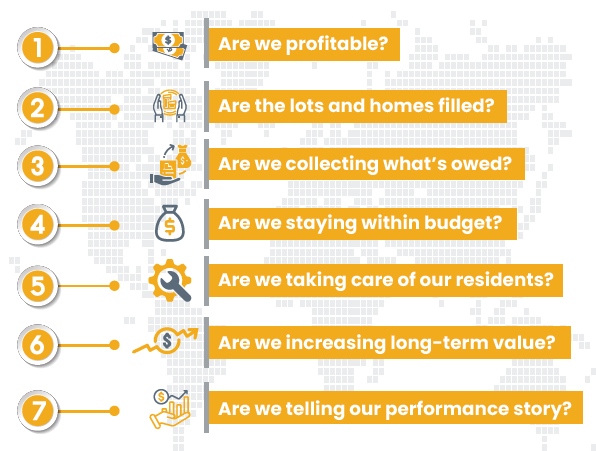
The Seven Questions

The best MH operators don’t leave performance to chance. They measure what matters, take action early, and deliver predictable results quarter after quarter.
The Manufactured Housing Performance Playbook gives you a simple, proven framework to track, improve, and showcase your portfolio’s performance. Built around 7 fundamental questions.

Manufactured Housing 7 Questions

What You Will Learn

Track KPIs for the 7 essential areas​

Measure profitability, occupancy, collections, and expenses with clarity.

Uncover risks early and make better financial decisions

Improve resident satisfaction and protect long-term asset value

Build investor and lender confidence through clear reporting

Download the Playbook